
Medullary Thyroid Cancer: The Calcitonin Cancer and Why It Is Treated Differently
Written by John P. Sabra, MD FACS
Updated September 2026
Educational only. This article is not medical advice. Always consult your physician about your individual situation.
Medullary thyroid cancer is uncommon, accounting for only 3 to 5% of thyroid cancer diagnoses, but it is fundamentally different from the more common papillary and follicular cancers in nearly every way that matters: the cell of origin, the genetics, the markers used to track it, the treatment, and the surveillance. If you have been diagnosed with medullary thyroid cancer, the most important thing to know early is that this disease requires a medical team experienced specifically in the treatment of it.
Most thyroid cancers arise from the follicular cells, which make thyroid hormone. Medullary thyroid cancer arises from a different cell population called the parafollicular cells or C-cells. These cells make a hormone called calcitonin, which plays a role in the calcium regulation in adults and also serves as an extremely useful tumor marker when the cells become cancerous. The presence of calcitonin in the blood is one of the defining features of medullary thyroid cancer, and it is the basis for how the disease is diagnosed, staged, and followed.
Medullary thyroid cancer also has a strong genetic component. Approximately 75% of cases are sporadic, occurring in patients with no family history. The remaining 25% are inherited, caused by a mutation in a gene called RET, and frequently occur as part of a syndrome called Multiple Endocrine Neoplasia type 2 (MEN2). Genetic testing is part of the standard workup for every patient newly diagnosed with medullary thyroid cancer, regardless of family history.
Why the Diagnosis Is Often Delayed
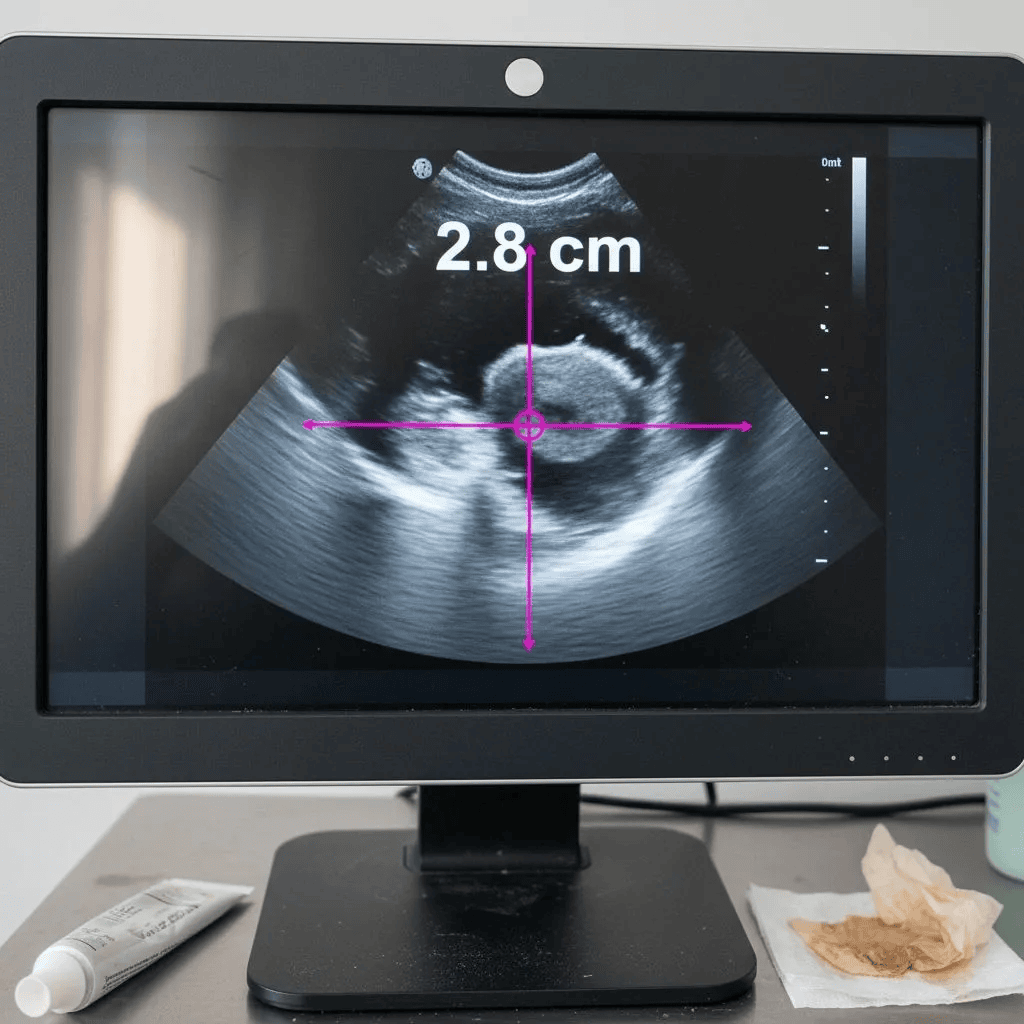
Medullary thyroid cancer is often diagnosed later than other thyroid cancers, for two reasons. First, it is rare enough that it is not routinely on the differential when a patient presents with a thyroid nodule. Second, the cells do not appear on ultrasound or biopsy in the same way that papillary cancer cells do. The classic biopsy features include sheets of cells with chromatin, and the diagnosis can be difficult for a pathologist who has not seen many cases.
When the diagnosis is suspected, a serum calcitonin level should be measured. An elevated calcitonin level in the presence of a thyroid nodule is highly suggestive of medullary thyroid cancer. CEA (carcinoembryonic antigen) is also a commonly elevated serum blood result and is used as an additional tumor marker. Both should be checked before surgery to establish a baseline.
The American Thyroid Association recommends genetic testing for the RET gene mutation in every patient diagnosed with medullary thyroid cancer, even when there is no family history. A positive result has implications not only for the patient but for first-degree relatives, who may carry the same mutation and benefit from prophylactic thyroidectomy before cancer develops.
Sporadic vs. Inherited: Why the Distinction Matters
Approximately 75% of medullary thyroid cancer cases are sporadic, meaning they occur in patients without an inherited gene mutation. These cancers are usually single tumors confined to one lobe of the thyroid and tend to occur later in adulthood (typically 50’s and 60’s age group).
The remaining 25% of cases are caused by inherited mutations in the RET proto-oncogene. These cases are part of the MEN2 syndromes, which come in two main forms.
-
MEN2A: The most common inherited form. Patients have medullary thyroid cancer, pheochromocytoma (an adrenal tumor), and primary hyperparathyroidism. Each can occur at different ages, and surveillance for all three is lifelong.
-
MEN2B: Less common but more aggressive. Patients develop medullary thyroid cancer in childhood, often with pheochromocytoma and characteristic physical features. Early prophylactic thyroidectomy is essential.
-
Familial medullary thyroid cancer (FMTC): A variant in which medullary cancer is the only manifestation. Less common; some experts now consider this a milder form of MEN2A.
For patients with inherited disease, screening for pheochromocytoma must be performed before any thyroid surgery, because an undetected pheochromocytoma can cause a life-threatening blood pressure crisis during anesthesia. Calcium and parathyroid hormone levels should also be assessed to evaluate for hyperparathyroidism.
Surgical Treatment
The treatment of medullary thyroid cancer is surgical. Unlike papillary cancer, where lobectomy is an option for many patients, the standard of care for medullary cancer is total thyroidectomy, and central neck lymph node dissection is performed in essentially every case.
| Disease Characteristic | Standard Surgical Approach |
|---|---|
| Confined to thyroid, no lymph node involvement | Total thyroidectomy plus central neck dissection. |
| Central neck node involvement | Total thyroidectomy plus central neck dissection plus consideration of ipsilateral lateral neck dissection. |
| Bilateral lateral neck involvement | Total thyroidectomy plus central plus bilateral lateral neck dissection. |
| RET mutation carrier, no detectable disease | Prophylactic total thyroidectomy, timing based on specific RET mutation. |
Radioactive iodine therapy is not effective in medullary thyroid cancer because the C-cells do not absorb iodine. This is one of the defining differences from papillary and follicular cancers. Complete and meticulous initial surgery is therefore even more important in medullary cancer than in differentiated cancers, because adjuvant therapies are more limited.
Medullary thyroid cancer surgery should be performed by a surgeon who is capable of handling this diagnosis specifically. The combination of a total thyroidectomy plus central node dissection and a possible lateral neck dissection is one of the more technically demanding operations in endocrine surgery. Complication rates and recurrence rates correlate strongly with surgeon volume and experience. This is not a diagnosis to treat at a local hospital with a low-volume surgeon.
Surveillance After Surgery
The surveillance of medullary thyroid cancer relies on serum calcitonin and CEA levels measured at regular intervals after surgery. In a patient cured of disease, calcitonin should fall to undetectable levels within a few months of surgery. A persistent elevated calcitonin after surgery means there is some level of residual disease somewhere. A rising calcitonin during follow-up means recurrent disease.
The doubling time of calcitonin (how quickly it rises) is an important prognostic marker in medullary thyroid cancer. A slow doubling time (years) suggests indolent disease that may be managed with surveillance. A short doubling time (months) suggests aggressive disease and prompts evaluation for systemic therapy.
Targeted Therapy for Advanced Disease
For patients with metastatic or progressive medullary thyroid cancer who are not surgical candidates, targeted therapy has changed the treatment approach over the past decade. Drugs that block the RET-kinase pathway are approved for RET-mutated medullary cancers and have produced durable responses in many patients with previously untreatable disease. Targeted therapy for advanced thyroid cancer is now a standard part of the conversation for selected patients.
The Bottom Line
Medullary thyroid cancer is uncommon, is biologically distinct from the more common thyroid cancers, and demands a treatment approach tailored to its specific features. Approximately one in four cases is inherited, and genetic testing is part of the standard workup for every patient. Surgery is the only curative treatment, as radioactive iodine does not work, and targeted therapy has become an important option for advanced disease.
If you have just been diagnosed with medullary thyroid cancer, ask your team about genetic testing for RET, screening for pheochromocytoma, and the surgical plan including the extent of neck lymph node dissection.
This article is intended for patient education only. It does not constitute medical advice and does not replace a consultation with your physician. Individual patient circumstances and clinical judgment determine the appropriate evaluation and management for every patient.
More from the Thyroid Cancer series



Ready to Talk to a Specialist?
A thyroid specialist can review your specific results, answer your questions, and help you understand exactly what your next steps should be. The ATLAS network connects you with experienced thyroid and parathyroid expert physicians who focus on thyroid disease.
Find a Thyroid Specialist Near You →