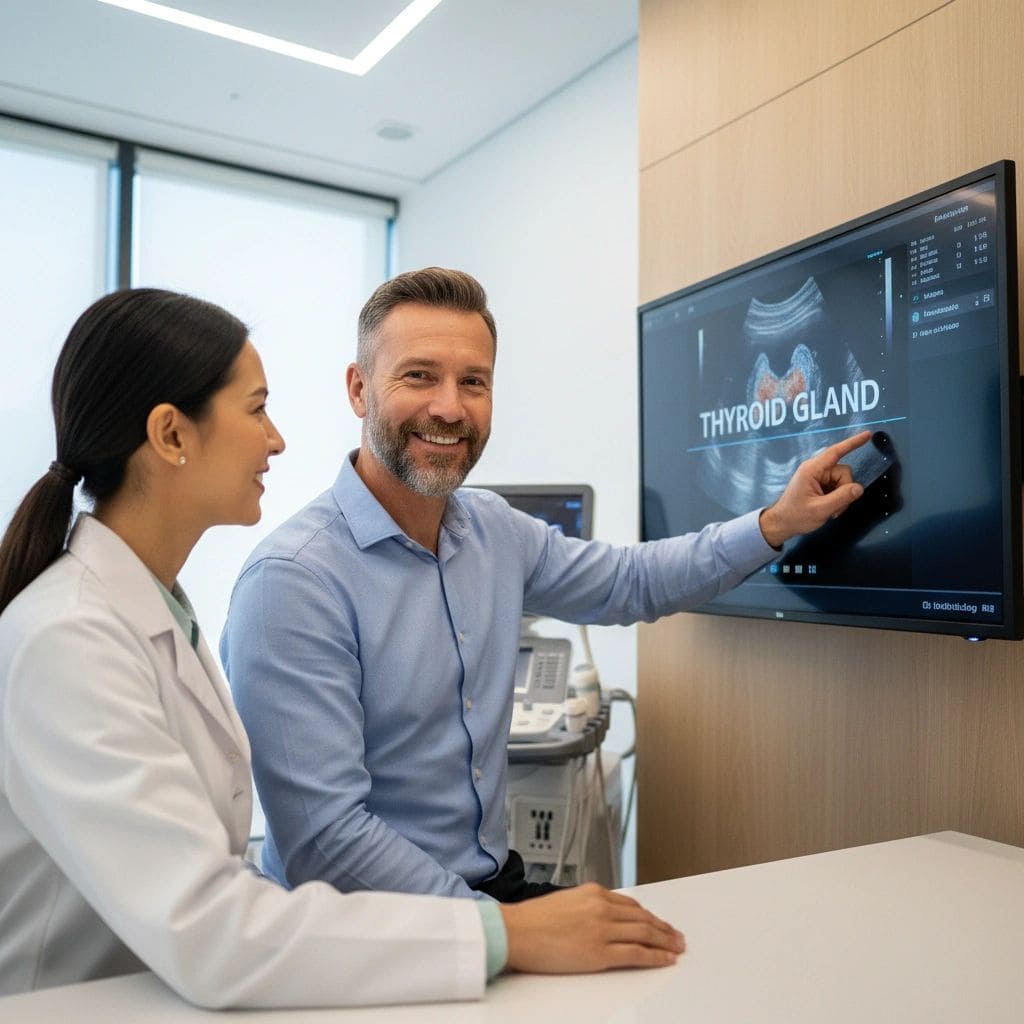
RFA for a Hot (Toxic) Thyroid Nodule: When Ablation Treats Hyperthyroidism
Written by John P. Sabra, MD FACS
Updated September 2026
Educational only. This article is not medical advice. Always consult your physician about your individual situation.
A toxic thyroid nodule is a single nodule that produces thyroid hormone autonomously, regardless of the body’s need. It causes hyperthyroidism. The traditional treatments have been radioactive iodine therapy, antithyroid medication, or surgery. Radiofrequency ablation has emerged as a fourth option that can resolve the hyperthyroidism by destroying the overactive tissue while preserving the rest of the thyroid. For selected patients, it is a particularly attractive choice.
A toxic nodule, also called an autonomously functioning thyroid nodule, has escaped the normal regulation that suppresses thyroid hormone production when blood levels are adequate. The TSH falls because the body senses the excess hormone, but the nodule keeps producing regardless. The result is hyperthyroidism: weight loss, palpitations, heat intolerance, anxiety, and sometimes atrial fibrillation. Diagnosis is confirmed by a thyroid scan showing a focal area of intense uptake (a “hot” nodule) with the rest of the thyroid suppressed.
Why RFA Works for Toxic Nodules
The overactive cells in a toxic nodule sit physically within the nodule itself. The rest of the thyroid is normal and is being suppressed by the elevated hormone levels coming from the nodule. Destroying the nodule with RFA eliminates the source of excess hormone. The suppressed normal thyroid tissue then resumes its own normal function, and the hyperthyroidism resolves.
Published series have shown that approximately 60 to 80% of patients with a toxic nodule become biochemically euthyroid (normal thyroid hormone levels with normal TSH) after RFA. The remainder either need a second RFA session or convert to another treatment. The thyroid gland is preserved, and lifelong medication is not required in most successful cases.
⚕ Clinical note The success of RFA for a toxic nodule depends on completely destroying the autonomous tissue. Partial treatment can fail to resolve the hyperthyroidism. Centers experienced with the procedure use complete ablation strategies including overlapping treatment zones and careful planning to address the entire functional volume.
Comparing the Treatment Options for Toxic Nodules
| Treatment | Outcomes | Considerations |
|---|---|---|
| Radioactive iodine (RAI) | High cure rate (over 80%) | Radiation exposure, possible later hypothyroidism, isolation period after treatment. |
| Surgery (lobectomy) | Definitive removal | General anesthesia, neck incision, small surgical risk, possible hormone replacement. |
| RFA | 60 to 80% biochemical cure | No radiation, no incision, no general anesthesia. Less consistent rate than RAI or surgery. |
| Antithyroid medication | Suppression only, not curative for autonomous nodules | Used as a bridge or in patients who decline definitive treatment. |
Who Is a Particularly Good Candidate for RFA
-
Younger patients who want to avoid radioactive iodine: Avoiding lifetime radiation exposure can be a meaningful consideration, especially for women considering pregnancy.
-
Patients with a single moderately sized toxic nodule: 1 to 4 cm is the typical range.
-
Patients who want to avoid general anesthesia and surgery: A meaningful preference for many patients.
-
Patients who want to preserve thyroid function and avoid lifelong levothyroxine: RFA largely preserves normal thyroid function.
-
Patients whose toxic nodule is in a favorable anatomic location: Away from critical structures and accessible to the needle.
Who Is Not a Good Candidate
-
Toxic multinodular goiter (multiple toxic nodules): Treating one nodule does not address the others. RAI or surgery is usually a better choice.
-
Very large toxic nodules (over 4 to 5 cm): Complete ablation is more challenging; outcomes are less reliable.
-
Severe hyperthyroidism: May require medical stabilization before any definitive treatment.
-
Substernal nodules: Out of reach of the needle.
-
Suspicious-appearing cytology: A toxic nodule that is not benign on biopsy is treated as cancer until proven otherwise.
⚕ Clinical note A toxic nodule still requires a biopsy in many cases before RFA, even though the imaging features and thyroid scan are strongly suggestive of a benign autonomous nodule. The reason is that RFA destroys the tissue without leaving anything to examine afterward. Most centers require Bethesda II biopsy results before proceeding, particularly when the nodule has any features that are not entirely classic for autonomous benign function.
What to Expect After RFA for a Toxic Nodule
Thyroid function tests are followed at 1, 3, 6, and 12 months. Hyperthyroidism typically resolves within 1 to 3 months as the destroyed nodule is absorbed and the normal thyroid resumes function. TSH normalizes, and free T4 and T3 return to normal levels. Patients on antithyroid medication can usually taper off in the early months after RFA under endocrinologist guidance.
For patients who do not fully resolve hyperthyroidism after the first RFA, a second session at 6 months is reasonable. Patients who fail two RFA sessions are typically converted to RAI or surgery.
The Bottom Line
RFA is an effective option for selected patients with a single toxic thyroid nodule causing hyperthyroidism. Approximately 60 to 80% achieve biochemical cure with one or two sessions, preserving the thyroid gland and avoiding the trade-offs of radioactive iodine or surgery. The procedure is most appropriate for moderately sized nodules in favorable anatomic locations, performed at centers experienced with the technique.
If you have hyperthyroidism from a single autonomous nodule, ask your endocrinologist whether RFA is a reasonable option in your case alongside the traditional treatments.
This article is intended for patient education only. It does not constitute medical advice and does not replace a consultation with your physician. Individual patient circumstances and clinical judgment determine the appropriate evaluation and management for every patient.
More from the Options Besides Surgery series



Ready to Talk to a Specialist?
A thyroid specialist can review your specific results, answer your questions, and help you understand exactly what your next steps should be. The ATLAS network connects you with experienced thyroid and parathyroid expert physicians who focus on thyroid disease.
Find a Thyroid Specialist Near You →