
Life After RFA: What Months 1, 6, and 12 Look Like
Written by John P. Sabra, MD FACS
Updated September 2026
Educational only. This article is not medical advice. Always consult your physician about your individual situation.
Unlike surgery, which produces an immediately visible result, radiofrequency ablation (RFA) produces a result that unfolds over months. The nodule does not shrink overnight. It does not even shrink dramatically in the first month. The treated tissue is absorbed by the body gradually, and the volume reduction happens over months. Knowing the timeline in advance turns months of waiting into months of expected progression.
Immediately after RFA, the treated nodule is essentially the same size as before treatment. The tissue inside is no longer viable, but the body has not yet absorbed it. Some patients are surprised that they cannot tell, looking in the mirror, that anything has changed. This is normal. The work of shrinkage takes time.
The First 1 to 2 Weeks
The neck may feel slightly swollen, tender, or warm in the first few days after the procedure. Some patients have a small bruise at the needle entry site, and th enodule may actually appear larger due to swelling. Pain is usually mild and managed with over-the-counter acetaminophen. Anti-inflammatories are typically avoided in the first 48 hours because they can slightly increase bruising risk.
Most patients return to normal activities within 24 to 48 hours. There is no incision to care for, no sutures to remove, and no period of restricted activity comparable to what follows thyroid surgery. The throat may feel slightly scratchy if the nodule was close to the trachea, and the voice may feel slightly tired for a few days. Both should resolve quickly.
⚕ Clinical note: A small amount of skin discoloration at the needle entry site is normal and resolves in a few weeks. Worsening pain, redness, fever, or persistent swelling beyond the first week is worth reporting to the team that performed the procedure. Infection after thyroid RFA is very uncommon but possible.
Month 1: Early Shrinkage Begins
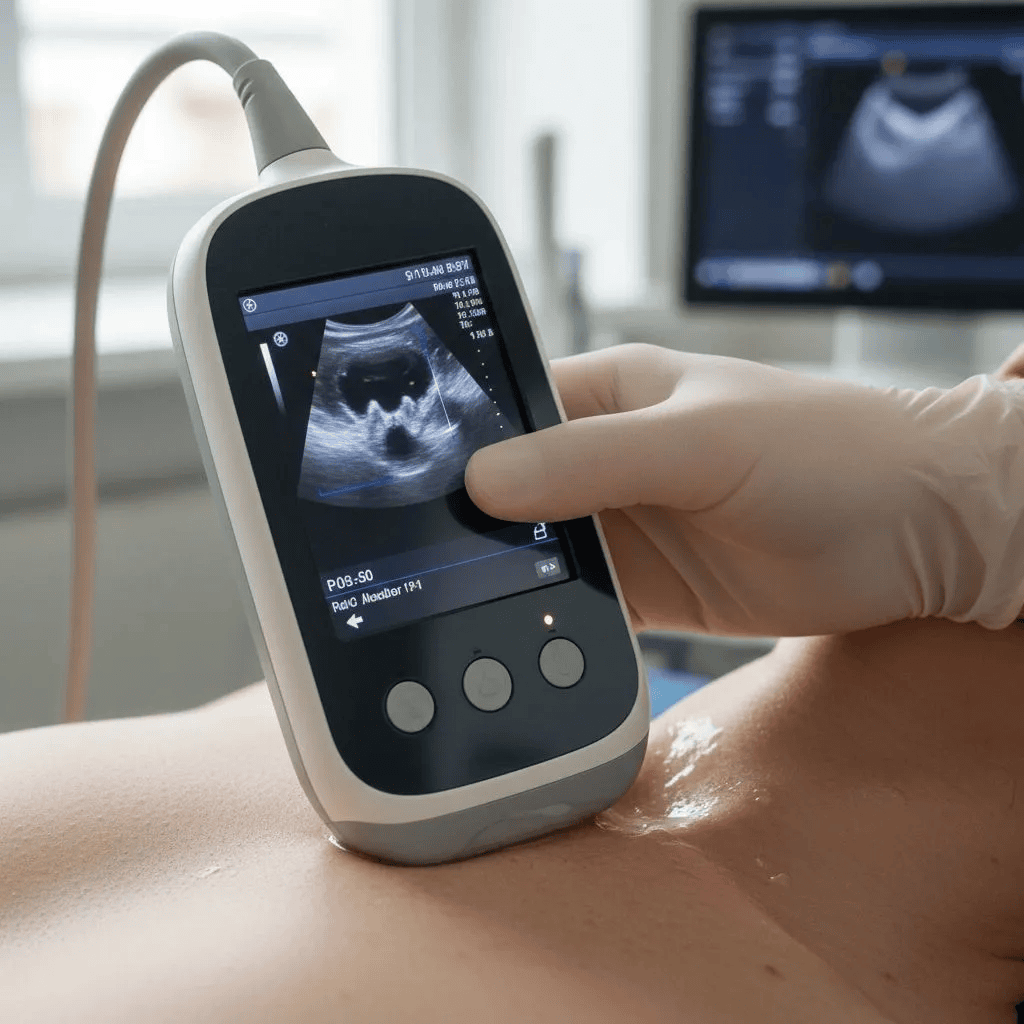
At the one-month follow-up ultrasound, most patients see modest shrinkage of the treated nodule, typically 10 to 30% volume reduction. The neck looks similar to before treatment, but the nodule on ultrasound is measurably smaller. Symptoms from pressure or cosmetic concern may be slightly improved, but the full benefit is not yet apparent. Thyroid function tests are usually checked to confirm normal thyroid hormone levels.
Months 3 to 6: The Main Shrinkage Period
This is the period of greatest visible change. Most volume reduction occurs in months 2 through 6. By 6 months, the typical treated nodule has shrunk by 50 to 70%. Patients usually notice visible improvement in neck appearance, reduction in pressure symptoms, and resolution of the original concerns that prompted treatment. The follow-up at 6 months is often the visit where patients feel confident the procedure worked.
| Time Point | Typical Volume Reduction | What Patients Notice |
|---|---|---|
| 1 month | 10 to 30% | Modest if any external change. |
| 3 months | 30 to 50% | Visible improvement starting. |
| 6 months | 50 to 70% | Clear improvement, most symptoms resolved. |
| 12 months | 60 to 85% | Final or near-final result reached. |
Month 12: Final Result Approached
By 12 months, most of the shrinkage has occurred. Additional reduction beyond this point is possible but typically modest. The final volume reduction depends on the original size of the nodule, its tissue composition, and how completely it was treated. Solid nodules tend to shrink less than mixed or cystic ones; large nodules tend to shrink as a percentage but may still have residual size that is noticeable.
Thyroid function tests are typically checked at 6 and 12 months. The great majority of patients have completely normal thyroid function. RFA destroys only the treated nodule; the surrounding normal thyroid tissue continues to function. Lifelong levothyroxine is not required after thyroid RFA.
If a Second Treatment Is Needed
A subset of patients have a partial response to the first RFA, particularly for larger nodules. A second RFA session is reasonable and is often performed at 6 to 12 months after the first if the residual nodule is still causing symptoms or is judged inadequately treated. Repeat treatments are well-tolerated and produce additional shrinkage. Some centers plan for a possible second session from the beginning for nodules over 3 cm.
⚕ Clinical note: Regrowth of treated nodules is uncommon but possible. Most patients have stable or continued slow shrinkage years after treatment. A nodule that begins to grow again on long-term surveillance can usually be retreated with RFA or, depending on the situation, considered for surgery.
Long-Term Follow-Up
After the first 12 months, follow-up ultrasound is typically performed annually for the first 2 to 3 years and then less frequently. Thyroid function tests continue at the same intervals. The long-term outlook for patients treated with RFA for benign nodules is very favorable. Most patients have durable resolution of symptoms with preservation of normal thyroid function.
The Bottom Line
The result of thyroid RFA unfolds over months rather than days. Most volume reduction occurs in months 2 through 6, and the final result is usually approached by 12 months. Most patients have 50 to 80% volume reduction at one year and complete symptom resolution. Thyroid function remains normal in the great majority of patients, and no lifelong medication is needed. A second RFA session is reasonable for incomplete responses and is well-tolerated.
Plan for follow-up ultrasounds at 1, 3, 6, and 12 months after RFA, and expect most of the visible change to occur between months 2 and 6.
This article is intended for patient education only. It does not constitute medical advice and does not replace a consultation with your physician. Individual patient circumstances and clinical judgment determine the appropriate evaluation and management for every patient.
More from the Options Besides Surgery series



Ready to Talk to a Specialist?
A thyroid specialist can review your specific results, answer your questions, and help you understand exactly what your next steps should be. The ATLAS network connects you with experienced thyroid and parathyroid expert physicians who focus on thyroid disease.
Find a Thyroid Specialist Near You →