Whole-Body Iodine Scan After Thyroid Cancer Surgery
Written by John P. Sabra, MD FACS
Updated September 2026
Educational only. This article is not medical advice. Always consult your physician about your individual situation.
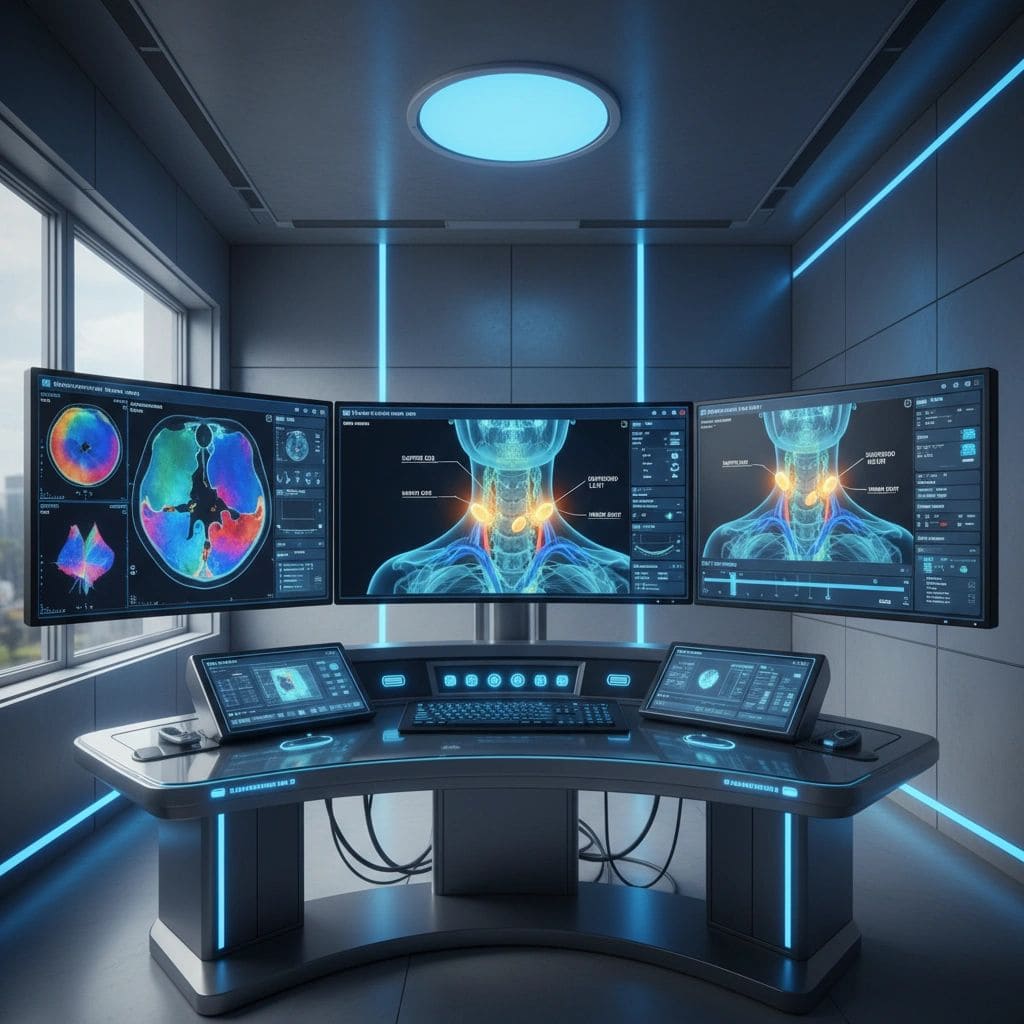
The whole-body iodine scan uses radioactive iodine (RAI) to find thyroid cells anywhere in the body. After thyroid cancer surgery, it is one of the most useful tests for assessing whether all thyroid tissue has been removed and whether any cancer remains. The scan is most commonly performed alongside radioactive iodine therapy, but it has specific roles in surveillance as well.
Thyroid follicular cells, both normal and differentiated cancer cells, take up iodine. After a total thyroidectomy, any iodine taken up by cells in the body indicates that thyroid tissue, whether it’s normal or cancerous, remains somewhere. The whole-body iodine scan exploits this property by giving a small dose of radioactive iodine and imaging where it accumulates.
The scan is used at two main time points: as a diagnostic scan to assess residual disease before deciding about RAI therapy, and as a post-treatment scan to confirm where the RAI dose went and what disease may remain after treatment.
How the Scan Is Done
You are prepared with either thyroid hormone withdrawal (stopping levothyroxine for several weeks to raise TSH) or recombinant TSH (Thyrogen injections to raise TSH temporarily). High TSH stimulates iodine uptake by thyroid cells, making the scan more sensitive. A low-iodine diet for 1 to 2 weeks reduces background iodine and improves the scan’s quality.
A small dose of radioactive iodine is given by mouth as a capsule or liquid. Whole-body imaging is then performed 24 to 72 hours later. The radioactive iodine is taken up by any remaining thyroid tissue and appears as bright spots on the imaging scan.
⚕ Clinical note: The low-iodine diet is essential for an accurate scan. Common high-iodine foods to avoid include seafood, iodized salt, dairy products, and certain food additives. The endocrinologist or nuclear medicine team provides specific dietary instructions. Following the diet strictly affects the quality of the scan and helps it to be more accurate.
Diagnostic Scan vs. Post-Treatment Scan
-
Diagnostic whole-body scan: Uses a small dose of radioactive iodine. Performed before deciding about RAI therapy, or to assess for recurrent disease during surveillance. Less sensitive than post-treatment scans but enough to guide treatment decisions.
-
Post-treatment whole-body scan: Performed 5 to 7 days after RAI therapy, using the therapeutic dose itself to image. More sensitive than diagnostic scans. Confirms where the treatment dose went and may identify previously hidden disease.
What the Scan Shows
-
Residual thyroid tissue in the neck: Normal after total thyroidectomy if a small amount of tissue near the trachea was left behind. RAI ablates this remnant.
-
Iodine-avid lymph node metastases: Hot spots in the central or lateral neck indicating cancer spread to lymph nodes.
-
Distant metastases: Most commonly in the lungs (diffuse uptake throughout the chest) or bones (focal hot spots in the skeleton).
-
Normal physiologic uptake: The salivary glands, stomach, and bladder normally accumulate iodine and are not signs of disease.
| Scan Finding | What It Means |
|---|---|
| Small focal uptake in thyroid bed | Residual normal thyroid tissue. Targeted by RAI. |
| Hot spots in lateral neck | Lymph node metastasis. RAI may be effective for small disease; large nodes usually need surgery. |
| Diffuse lung uptake | Pulmonary metastases. May be responsive to higher RAI doses. |
| Focal bone uptake | Bone metastasis. May warrant a combination of RAI and other therapies. |
| Negative whole-body scan with rising Tg | Suggests iodine-refractory disease. Further imaging and treatment options reconsidered. |
When the Scan Is Most Useful and When It Is Not
The whole-body iodine scan is most useful when the cancer cells continue to take up iodine. Over time, some thyroid cancers lose the ability to absorb iodine and become “iodine-refractory”. In these cancers, the scan turns negative even when active disease is present. PET imaging and other modalities then take over as the primary surveillance tools.
For medullary thyroid cancer and anaplastic thyroid cancer, the whole-body iodine scan is not useful at all. These cancers do not absorb iodine. Surveillance relies on different markers and imaging modalities.
⚕ Clinical note: A rising thyroglobulin with a negative whole-body iodine scan can be a cancer surveillance finding. It suggests that thyroid cancer cells are present somewhere but no longer absorbing iodine. Next steps include neck ultrasound, CT or MRI, and increasingly FDG-PET to localize disease that the iodine scan cannot detect.
The Bottom Line
The whole-body iodine scan identifies thyroid tissue, normal or cancerous, anywhere in the body by detecting the iodine uptake of thyroid cells. It is used before RAI therapy to plan treatment, after RAI to confirm where the dose went, and during surveillance for selected patients. The scan is most useful for iodine-avid differentiated thyroid cancers and is not informative for medullary or anaplastic cancers, or for cancers that have become iodine-refractory.
If a whole-body iodine scan is being planned, follow the low-iodine diet exactly as instructed and ask whether thyroid hormone withdrawal or recombinant TSH preparation will be used.
This article is intended for patient education only. It does not constitute medical advice and does not replace a consultation with your physician. Individual patient circumstances and clinical judgment determine the appropriate evaluation and management for every patient.
More from the Thyroid Cancer series



Ready to Talk to a Specialist?
A thyroid specialist can review your specific results, answer your questions, and help you understand exactly what your next steps should be. The ATLAS network connects you with experienced thyroid and parathyroid expert physicians who focus on thyroid disease.
Find a Thyroid Specialist Near You →