I Found a Thyroid Nodule: Start Here
Written by John P. Sabra, MD FACS
Updated September 2026
Educational only. This article is not medical advice. Always consult your physician about your individual situation.
A thyroid nodule was found. Maybe your doctor felt it during an exam. Maybe it turned up by accident on a CT scan you had for something else. Maybe a screening ultrasound caught it. The first reaction is almost always the same: is this cancer?
The evidence-based answer is that the great majority of thyroid nodules are not cancer, that the workup is well defined, and that anxiety about this can be settled with rapidly available information.
Thyroid nodules are extraordinarily common. Studies using high-resolution ultrasound have shown that roughly 50% of adults over age 50 have one or more thyroid nodules. Most are benign and require no treatment. Approximately 5 to 10% of thyroid nodules are cancerous. Most of those cancers are slow-growing, highly treatable, and associated with excellent long-term survival.
The standard pathway from “a nodule was found” to “you have a plan” is structured, predictable, and well supported by evidence. It has three main stops: ultrasound risk stratification, biopsy if indicated, and a decision about treatment or surveillance based on the results. Knowing that this is a stepwise process makes the early weeks of information gathering and evaluation much easier.
Step 1: Get a Dedicated Thyroid Ultrasound
If a nodule was found by physical exam or on a CT, MRI, or other imaging, the next step is a focused thyroid ultrasound performed by a radiologist or sonographer experienced with the thyroid. Ultrasound is the single most useful test for assessing a thyroid nodule. It defines the size of the nodule, its precise location, its internal features, and the appearance of nearby lymph nodes.
The ultrasound report will usually include a TIRADS score, a standardized risk classification from TR1 (benign-appearing) to TR5 (highly suspicious). The TIRADS score determines whether a biopsy is recommended and at what size threshold.
⚕ Clinical note: A nodule discovered on a non-thyroid scan such as a chest CT or a carotid ultrasound is called an incidental nodule. The original scan was not designed to evaluate the thyroid. A dedicated thyroid ultrasound is the right next step. Do not rely on a description of the nodule from the original report. The level of detail needed to make decisions comes from a focused ultrasound.
Step 2: Decide Whether a Biopsy Is Needed
The decision to perform a biopsy is based on the TIRADS score and the size of the nodule. The standard thresholds are:
| TIRADS Category | Biopsy Recommended at |
|---|---|
| TR1 (benign) | No biopsy. |
| TR2 (not suspicious) | No biopsy. |
| TR3 (mildly suspicious) | 2.5 cm or larger. |
| TR4 (moderately suspicious) | 1.5 cm or larger. |
| TR5 (highly suspicious) | 1.0 cm or larger. |
Below the size threshold, the standard approach is interval surveillance rather than immediate biopsy, although the final decision whether to biopsy or not is individualized to your case and decided by your doctor. Some lower suspicion nodules may get biopsied due to other factors such as family history of thyroid cancer.. Above the threshold, fine-needle aspiration biopsy is the next step. The biopsy is a brief office procedure under local anesthesia, takes about 10 to 20 minutes, and is well tolerated by patients.
Step 3: Interpret the Biopsy Result
Biopsy results are reported using the Bethesda classification system, a standardized framework with six categories (I through VI) and defined malignancy risks for each.
Bethesda I (non-diagnostic): Not enough cells. A repeat biopsy is recommended.
Bethesda II (benign): Reassuring. The nodule transitions to routine surveillance. This is the most common result.
Bethesda III (atypia of undetermined significance): Indeterminate. Options include repeat biopsy, molecular testing, or diagnostic surgery.
Bethesda IV (follicular neoplasm): Indeterminate, with a higher malignancy risk. Molecular testing or diagnostic surgery.
Bethesda V (suspicious for malignancy): High suspicion. Surgical referral.
Bethesda VI (malignant): Cancer confirmed. Treatment planning begins.
Step 4: Decide on Treatment or Surveillance
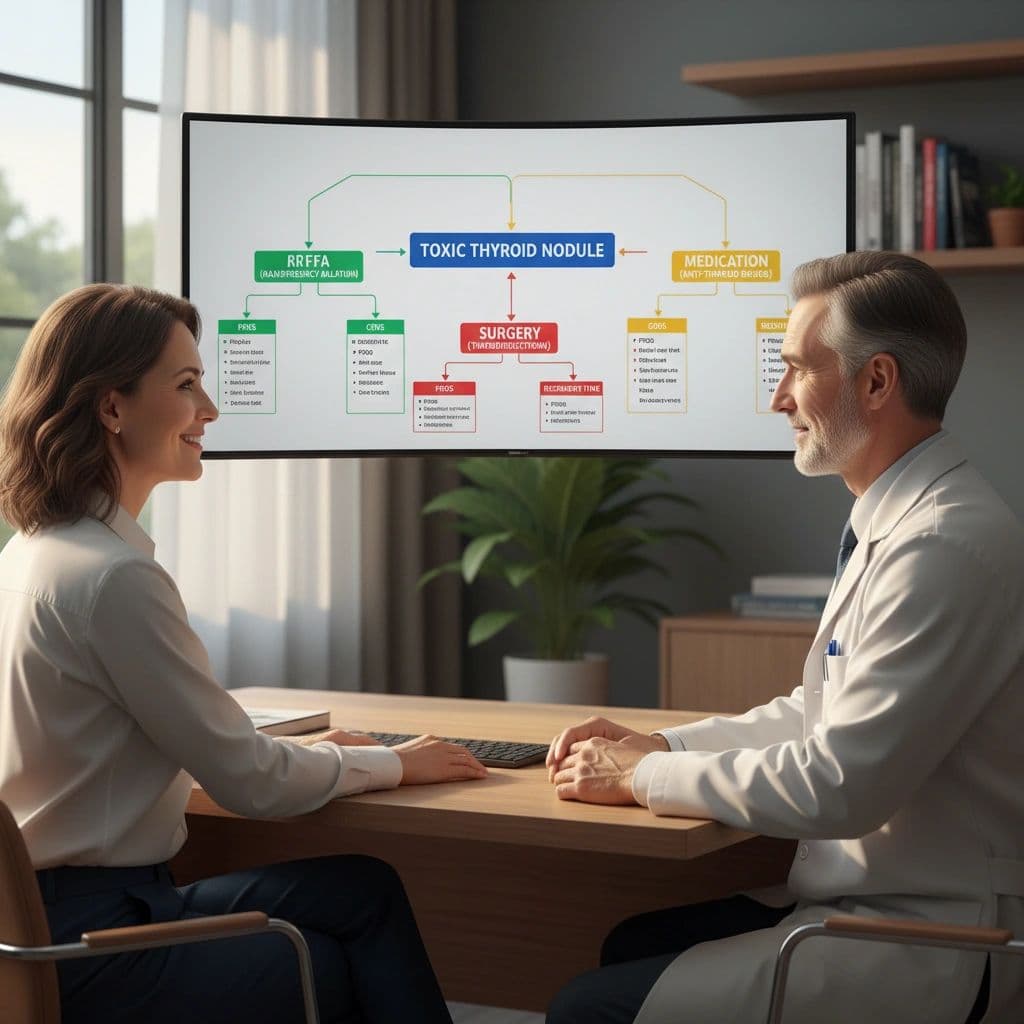
Most thyroid nodules do not require treatment. They are followed with periodic ultrasound to confirm they are not growing or developing concerning features. For nodules that do require treatment, the options have expanded considerably in recent years.
-
Surveillance only: For benign nodules without symptoms. Periodic ultrasound, less often over time.
-
Radiofrequency ablation (RFA): For benign nodules that cause symptoms or cosmetic concern. A non-surgical option that shrinks the nodule using heat.
-
Ethanol ablation: For benign cystic nodules. A simple injection treatment that often resolves the cyst.
-
Thyroid lobectomy: Removal of half the thyroid. For confirmed cancer in selected patients, or for larger benign nodules causing symptoms.
-
Total thyroidectomy: Removal of the entire thyroid. For higher-risk thyroid cancers, bilateral disease, or other specific indications.
⚕ Clinical note: The pathway from finding a nodule to having a definitive plan typically takes 4 to 8 weeks for most patients. This includes time for the ultrasound, the biopsy if needed, the result, and an initial consultation. With rare exceptions, a thyroid nodule is not an emergency, and patients have time to gather information, consult with the right specialists, and make decisions thoughtfully.
Who to See
The specialists involved in thyroid nodule care are endocrinologists and thyroid surgeons. The right initial consultation depends on the clinical situation. For a benign or low-risk nodule, an endocrinologist usually leads the care. For a nodule with a Bethesda IV, V, or VI biopsy, a thyroid surgeon should be involved early. For patients considering non-surgical treatment options like RFA, a physician and center that performs the procedure is the right place to start.
The Bottom Line
Most thyroid nodules are benign. The standard workup involves a dedicated thyroid ultrasound, a biopsy when size and features warrant one, and a decision based on the Bethesda result. The process is structured, predictable, and rarely urgent. Even when a nodule turns out to be cancer, the cancer is usually highly treatable and the long-term outlook is generally favorable.
If you have just learned you have a thyroid nodule, schedule a dedicated thyroid ultrasound and bring the report to a consultation with an endocrinologist or thyroid surgeon experienced with nodule evaluation.
This article is intended for patient education only. It does not constitute medical advice and does not replace a consultation with your physician. Individual patient circumstances and clinical judgment determine the appropriate evaluation and management for every patient.
More from the Ultrasound series



Ready to Talk to a Specialist?
A thyroid specialist can review your specific results, answer your questions, and help you understand exactly what your next steps should be. The ATLAS network connects you with experienced thyroid and parathyroid expert physicians who focus on thyroid disease.
Find a Thyroid Specialist Near You →