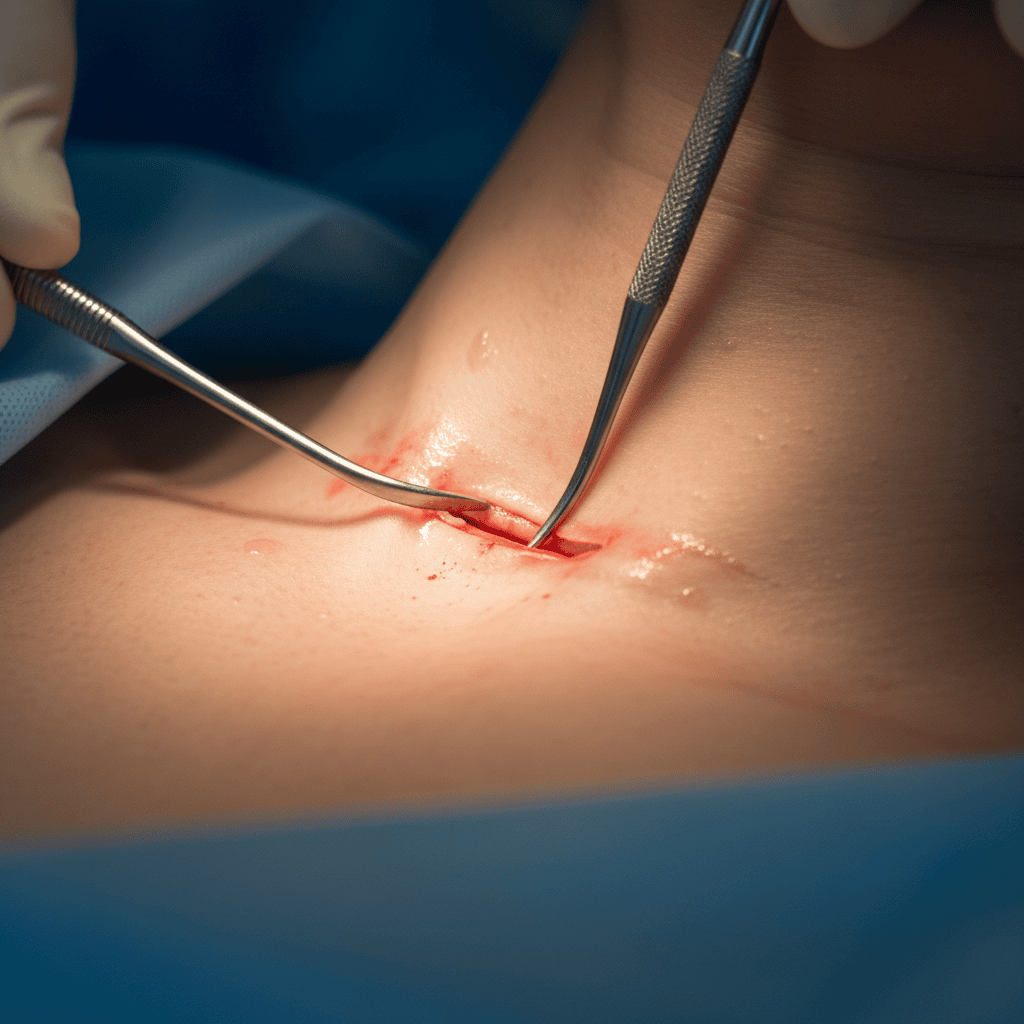
Your Thyroid Surgery Scar: What to Expect and How to Care for It
Written by John P. Sabra, MD FACS
Updated September 2026
Educational only. This article is not medical advice. Always consult your physician about your individual situation.
The appearance of the scar after thyroid surgery is one of the most common patient concerns, and it almost always turns out better than patients expect (if surgery is performed by a qualified surgeon). The neck incision sits in a natural skin crease, the scar fades substantially over the first year, and with consistent care most patients end up with a thin pale line that is hard to see at talking distance. The specifics of scar care are simple and worth doing well.
The standard thyroid surgery incision is a horizontal cut in the mid neck, typically 4 to 6 centimeters long, and placed in a natural skin crease whenever possible. This location works well because the skin of the lower neck heals favorably, the crease pattern hides the scar in normal head positions, and the area sees less mechanical stress and stretching than scars elsewhere on the body.
The Timeline of Scar Healing
| Time After Surgery | Typical Appearance |
|---|---|
| Days 1 to 7 | Closed incision covered with adhesive strips or surgical glue. Some swelling and redness around the edges. |
| Weeks 2 to 4 | Strips or glue come off. Incision is pink and may feel firm or slightly raised. |
| Months 1 to 3 | Pink to red color. Some lumpiness under the skin is normal. This is when the scar looks its worst, paradoxically. |
| Months 3 to 6 | Color fades. Lumpiness flattens. Scar becomes less noticeable. |
| Months 6 to 12 | Scar approaches its final appearance: usually a thin pale line. |
| Year 2 | Final scar quality. Continued minor improvement is possible, but most change has occurred by now. |
⚕ Clinical note: The scar usually looks worse at 1 to 3 months than at 12 months. Patients who see their scar at the 6-week follow-up are sometimes worried about its appearance. This is the period when scars are at their pinkest and lumpiest. The improvement over the following 6 months is substantial, and waiting for the natural fade is almost always the right approach before considering any cosmetic intervention.
The Most Important Step: Sun Protection
Sun exposure on a healing scar in the first 6 to 12 months is the single biggest reversible cause of a poor scar outcome. Ultraviolet light stimulates increased pigmentation in healing skin and can cause the scar to permanently darken. The thyroid scar sits on the lower neck, directly exposed to sun in normal daily life.
Apply broad-spectrum sunscreen, SPF 30 or higher: To the incision area whenever it will be exposed.
Reapply every 2 hours when outside: Particularly during the first 6 months.
Use a scarf, high collar, or sun-protective clothing: For prolonged outdoor activity or for the beach.
Avoid tanning: For at least the first year. Tanning intensifies scar pigmentation.
Products and Techniques That Help
Several scar care products have published evidence supporting their use. Most reduce scar redness, soften the scar, and improve the final appearance to a modest but real degree.
-
Silicone sheets or silicone gel: The most consistently evidence-supported scar treatment. Applied daily for several months. Available over the counter. The purer the silicone product, the better
-
Scar gels containing onion extract or allium cepa: Modest evidence of benefit. Often combined with silicone.
-
Vitamin E creams and oils: Limited evidence of benefit. Some patients report subjective improvement; well-controlled trials show little objective effect.
-
Gentle scar massage: Starting at 1 to 2 weeks after surgery. Helps soften firm areas. Light circular pressure for a few minutes daily.
When the Scar Is Not Healing Well
A small minority of patients form abnormal scars, either keloids (raised scars that grow beyond the original incision boundary) or hypertrophic scars (raised but staying within the original boundary). Patients with a personal or family history of keloid formation are at higher risk and should mention this to the surgeon before surgery.
Interventions for abnormal scarring include silicone gel, intralesional steroid injections, and in selected cases scar revision. These are typically considered at 12 months or later, when the scar has reached its mature appearance. Earlier intervention is occasionally appropriate for clearly hypertrophic scars that are not responding to standard care.
⚕ Clinical note: A red, raised, firm scar at 3 months is normal and almost always improves substantially over the following 6 months without intervention. A scar that is still problematic at 12 months is the point where consultation with a dermatologist or plastic surgeon becomes appropriate. The temptation to intervene early is understandable but rarely helps; most scars need time more than treatment.
The Bottom Line
The thyroid surgery scar fades substantially over the first year and usually becomes a thin pale line that is hard to see in normal head positions. Sun protection in the first 6 months is the single most useful step you can take for the long-term appearance. Silicone gel or sheets have evidence-supported benefit. The scar typically looks worse at 1 to 3 months than at 12 months. Most patients are pleased with the final result.
Apply broad-spectrum sunscreen to your incision area whenever it will be exposed, for at least the first 6 months after surgery.
This article is intended for patient education only. It does not constitute medical advice and does not replace a consultation with your physician. Individual patient circumstances and clinical judgment determine the appropriate evaluation and management for every patient.
More from the Recovery and Life After Surgery series




Ready to Talk to a Specialist?
A thyroid specialist can review your specific results, answer your questions, and help you understand exactly what your next steps should be. The ATLAS network connects you with experienced thyroid and parathyroid expert physicians who focus on thyroid disease.
Find a Thyroid Specialist Near You →