Minimally Invasive Parathyroid Surgery: The Modern Approach
Written by John P. Sabra, MD FACS
Updated May 2026
Educational only. This article is not medical advice. Always consult your physician about your individual situation.
Parathyroid surgery has evolved substantially over the past two decades. Where the traditional operation required a large neck incision, bilateral exploration of all four glands, and an overnight hospital stay, the modern minimally invasive approach uses a small incision, a focused dissection on one side, and same-day discharge for most patients. The cure rate is just as high. The recovery is significantly easier.
What Minimally Invasive Actually Means
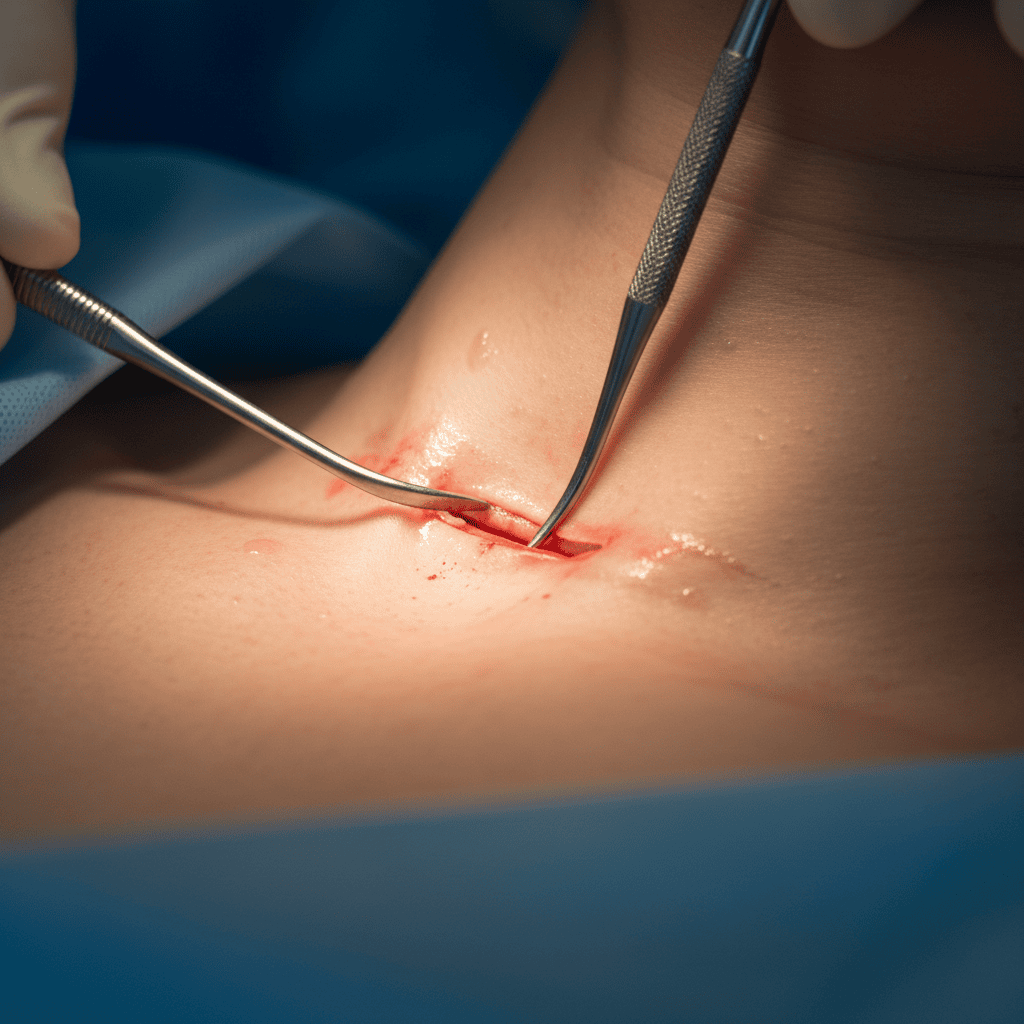
Minimally invasive parathyroid surgery is also called focused parathyroidectomy or directed parathyroidectomy. The terms describe an approach in which the surgeon, guided by preoperative imaging, targets the specific abnormal gland identified before surgery and removes it through a small incision, typically 1.5 to 2.5 centimeters in length, without exploring the other parathyroid glands.
The approach is possible because roughly 85% of patients with primary hyperparathyroidism have a single adenoma, and modern imaging (sestamibi scan and ultrasound) can usually identify which gland is the culprit before the first incision. When the imaging studies concordantly point to a single gland, the surgeon can plan a focused operation with confidence. Intraoperative parathyroid hormone monitoring confirms in real time that removing the identified gland has cured the hormone excess, providing the same assurance of completeness that used to require examining all four glands visually.
The Components That Make It Work
Minimally invasive parathyroid surgery is not simply the same operation through a smaller hole. It is a coordinated combination of preoperative, intraoperative, and perioperative elements that together allow a focused approach to produce outcomes equivalent to traditional surgery:
- Preoperative localization imaging: sestamibi scan and high-resolution neck ultrasound, sometimes complemented by 4D CT scan when needed, to identify which specific gland is abnormal
- Small, well-placed incision: 1.5 to 2.5 cm, positioned in a natural skin crease, on the side where imaging identified the adenoma
- Focused dissection: the surgeon targets the area where the adenoma is expected to be rather than examining all four parathyroid glands systematically
- PTH monitoring: a rapid parathyroid hormone assay drawn at least 10 minutes after removing the gland to confirm adequate drop in PTH (greater than 50% from baseline, with post-excision value in the normal range)
PTH monitoring and advanced intraoperative parathyroid gland detection technology are the safety net that makes focused surgery reliable. Without them, a surgeon removing a single gland based on imaging alone would be relying on visual assessment to confirm cure, which is less reliable in patients with multi-gland disease. These physiologic tests and technologies give your surgeon reassurance of a cure before the operation is concluded. A surgeon performing focused parathyroidectomy without them is practicing at a lower standard than the current evidence supports.
Advantages Over Traditional Bilateral Exploration
Direct comparisons between focused parathyroidectomy and traditional bilateral exploration in large published series consistently show:
| Dimension | Bilateral Exploration | Focused Parathyroidectomy |
|---|---|---|
| Incision length | 2 to 4 cm | 1.5 to 2.5 cm |
| Operating time | 30 to 60 minutes | 20 to 30 minutes |
| Anesthesia | General anesthesia standard | General anesthesia common; selected patients can have local anesthesia with sedation |
| Cure rate | 95 to 98% in experienced hands; higher long-term | 95 to 98% in experienced hands |
| Complication rate | Similar | Slightly lower for transient hypocalcemia |
| Cost | Higher (longer OR time, occasional overnight stay) | Lower per case in most published analyses |
The cure rates in the hands of experienced parathyroid surgeons are essentially equivalent, although bilateral exploration may offer slightly higher long-term cures. What differs is the short term patient experience: a smaller scar, a shorter operation, and a discharge with less postoperative recovery time. For patients who are candidates, these are meaningful quality-of-life differences.
Who Is a Candidate
Not every patient with primary hyperparathyroidism is a candidate for minimally invasive surgery. The typical criteria include:
- Biochemically confirmed primary hyperparathyroidism: elevated calcium and elevated or inappropriately normal PTH
- Concordant preoperative localization: sestamibi scan and ultrasound pointing to the same single gland
- No clinical features suggesting multi-gland disease: no family history of MEN1, no history suggesting hyperplasia
- No prior neck surgery: a previously operated neck has altered anatomy that may make focused surgery less reliable
- Reasonable patient anatomy: a short neck, a very low adenoma, or certain body habitus features may favor a different approach
When imaging is negative, discordant, or non-localizing (approximately 10 to 20% of cases), the surgeon plans for bilateral exploration from the start. This is not a failure. It is good surgical planning. A surgeon who attempts a focused approach despite negative imaging is committing to a more difficult operation with a lower chance of success.
Same-Day Discharge and What It Takes
Going home the same day as parathyroid surgery has become the standard at high-volume centers. Several things make this possible and safe:
- Short operation time (under an hour in most cases), limiting total anesthesia exposure
- Excellent intraoperative hemostasis using modern energy-sealing devices, reducing the risk of postoperative bleeding
- Early postoperative calcium supplementation to prevent symptomatic hypocalcemia
- An observation period in the recovery room with PTH monitoring before discharge
- Clear discharge instructions on recognizing tingling, numbness, and muscle cramping, and how to respond
Patients who go home the same day should have a family member or friend available for the first 24 hours, access to a phone to contact the surgical team, and clear calcium supplementation instructions. For patients with significant comorbidities, severe preoperative bone disease (where dramatic postoperative calcium drops are more likely), or patients who live far from their surgical team, an overnight stay remains appropriate.
Same-day surgery is a consequence of modern technique, not a cost-cutting measure. It is safer today than it was a generation ago because of better intraoperative hemostasis, more reliable calcium monitoring, and the use of rapid PTH testing to confirm a complete operation before the patient leaves the recovery room. A surgeon who offers same-day parathyroid surgery at a high-volume center is operating at the current standard of care.
What This Does Not Mean
Minimally invasive does not mean shortcut. It does not mean less thorough, less safe, or lower-quality. Performed correctly by an experienced surgeon, the focused approach is just as complete as bilateral exploration.
Minimally invasive also does not mean universally appropriate. The 15 to 20% of patients who turn out to have multi-gland disease, ectopic anatomy, or negative imaging should have bilateral exploration, and the surgeon should be as capable of performing that operation as the focused one. The best parathyroid surgeons are equally comfortable with both approaches and choose the right one for each patient based on the imaging, the biochemistry, and the intraoperative findings.
The Bottom Line
Minimally invasive parathyroid surgery is the modern standard for the majority of patients with primary hyperparathyroidism. It offers a smaller scar, a shorter operation, same-day discharge, and immediate cure rates that match the traditional bilateral exploration. It requires preoperative localization imaging, PTH monitoring, and a surgeon experienced in the approach.
If you have been diagnosed with primary hyperparathyroidism, ask your surgeon whether you are a candidate for focused parathyroidectomy, what imaging they will use to plan the approach, and whether PTH monitoring and the use of advanced technologies are a standard part of their practice. The answers tell you whether you are being offered the current standard of care.
References
- Wilhelm SM, et al. AAES Guidelines for the Definitive Management of Primary Hyperparathyroidism. JAMA Surg. 2016.
- American Association of Endocrine Surgeons — Patient Resources.
- NIH NIDDK — Primary Hyperparathyroidism.
This article was written by John P. Sabra, MD FACS and is intended for patient education only. It does not constitute medical advice and does not replace a consultation with your physician. Individual patient circumstances, imaging findings, and surgical judgment determine the appropriate approach for every patient.
More from the Parathyroid Disease series


Ready to Talk to a Specialist?
A thyroid specialist can review your specific results, answer your questions, and help you understand exactly what your next steps should be. The ATLAS network connects you with experienced thyroid and parathyroid expert physicians who focus on thyroid disease.
Find a Thyroid Specialist Near You →